WHAT SHOULD I CALL THESE MORELS? By Dianna Smith
There are at least twenty or so different species of morels in North America. Prior to 2012, we tended to call them by their common names or we used the well-known binomial names established by European mycologists. With DNA analysis, it has been shown that there are roughly four or five species of morels common to our region in the northeast and they are genetically different from the European versions. I will try to help you figure out what species we have and the current terminology we should consider using for what we find. Of course, calling them by their common names won’t offend the mushrooms themselves. Our various morel species are addressed below in the order in which they tend to appear in the spring.

Morchella angusticeps
Formerly known as Morchella elata, the Black Morel or Morchella angusticeps (Peck) has a conical or sub-conical cap and exhibits dark vertically arranged ridges and paler pits. The cap barely overhangs the granular stalk to which it is attached. Morchella angusticeps is typically the first of the four or five main eastern morels to appear in the spring. Like all morels, and unlike the brown to reddish brown gyromitras, which have a ‘stuffed interior,’ Morchella angusticeps is hollow. It is found growing solitary or grouped under several different species of hardwood and conifer trees, including tulip poplars, pines, oaks, etc.

Morchella punctipes
Morchella punctipes Peck (formerly known as Morchella semilibera or the half-free morel) is found growing scattered about or solitary under a variety of hardwoods from the Great Plains eastward. The name was recently changed because it was discovered that Morchella semilibera is a European species genetically different than our half-free morel. Like our black morel, it tends to appear earlier in the season than the yellow morels. It has a relatively small cap compared with other morels and a comparatively long, thin stipe. About halfway up, the cap is attached to the somewhat granular stalk. Note that like other true morels, the stipe and the cap are hollow.
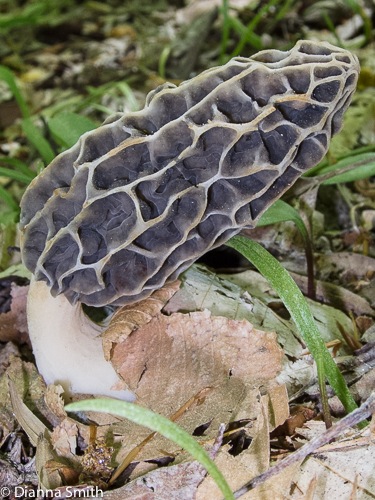
Morchella diminutiva
Previously Morchella diminutiva (Kuo, Dewsbury, Moncalvo and Stephenson) had been commonly called a gray, small yellow or tulip morel. It typically appears under tulip poplars. It is also not uncommon under ash, hickory and old apple trees. It is not found under pine. As might be guessed from the name, it is more petite than the large morels favored by most morel hunters. In fact, it most closely resembles the Black Morel, Morchella angusticeps, except that its sterile ridges and fertile pits are paler in comparison. Also, it may or may not have a smooth stipe. Morchella diminutiva is common from the Great Plains eastward.
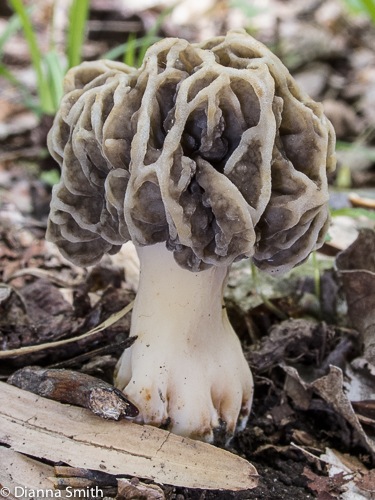
Morchella prava (or distorted Morchella diminutiva)
I am not positive about the identification of the morel depicted in this photo, though its habitat and morphological features tend to correspond with descriptions of Morchella prava Dewsbury, Moncalvo, J. D. Moore, and M. Kuo. The dark pits and pale ridges of Morchella prava are more randomly arranged than our other morel species. This mushroom tends to be found under pines and oaks and in wet, sandy environments near water from the 43rd degree latitude North.

Morchella americana (syn. Morchella esculentoides)
Morchella americana Clowez and C. Matherly (syn. Morchella esculentoides) is the meaty yellow morel most desired and sought after by morel hunters. It is the easiest of all our morels to serve stuffed with favorite cooking ingredients. Morchella americana is common east of the Rocky Mountains, and is found under dying American elms, living ash trees, and under very mature apple trees. It is also found in river bottoms and urban locations in the west. Note its pale infertile ridges and the irregularly shaped fertile pits. The base of the cap (hymenophore) is attached to the stipe. There is a lookalike found a bit further west called Morchella cryptica. It is apparently impossible to distinguish the two species without DNA analysis.
Two so-called ‘lookalikes’ of morels are verpas, which resemble the half-free morels, and convoluted-capped gyromitras which don’t resemble any morel, but which are nevertheless often confused with them by inexperienced mushroom hunters. Both have a stuffed rather than hollow interior. Both contain toxins and can reportedly be deadly eaten raw. The compounds in Gyromitras break down into monomethlhydrazine, a key component of rocket fuel. Although the amount and toxicity varies by species and from fruitbody to fruitbody, it is possible that the effects of consuming Gyromitras may be cumulative.
While all morels are considered choice edibles by most of us, the large yellow Morchella americana (syn. Morchella esculentoides) is a world-wide favorite. Often it is paired with wild leeks, which appear at the same time of year. Most of us prefer them cooked in butter or cream than in oil. Be aware that like Gyromitras, they are known to cause severe gastric distress when eaten raw or partially cooked. Also, note that some people have reported becoming sick after eating morels accompanied by a drink or two of an alcoholic beverage. So whatever you call them, be sure to cook them all thoroughly and savor their complex flavors.
For more detailed descriptions of these morels, please consult Michael Kuo's website www.mushroomexpert.com and Michael Beug, Arleen Bessette, and Alan Bessette's newly published reference book, Ascomycete Fungi of North America.