The Coprinoid Mushrooms
By Dianna Smith
When I first started learning the deliquescing mushrooms about twelve years ago, I was pleased that I could recognize several of them as belonging within the dark-spored genus Coprinus in the now defunct family, Coprinaceae. Since they had gills which dissolved from the outer edge upward into an inky liquid to release their spores, it was natural to think of them as related. In fact, the genus was rather large with well over a hundred saprobic members. Little did I know that it had already shrunk in size to just a few mushrooms that all resemble Coprinus comatus morphologically. All the other blackening mushrooms were split up into two overarching families, the Agaricaceae and the newly created Psathyrellaceae. Within these two groups, they were assigned to at least four recognized genera, Coprinus, Coprinopsis, Coprinellus, and Parasola. Auto-digestion seems to have evolved several times independently. Let's see if we can sort through some of the more common ones and place them into their respective genera based on characteristics visible to the eye.

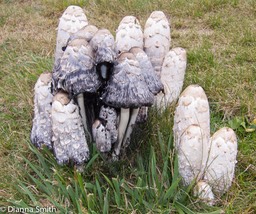
Coprinus comatus
COPRINUS
We'll begin by looking at the species type, Coprinus comatus. Its common names include the Shaggy Mane, the Lawyers Wig and the Inky Cap. Almost every amateur mycologist has encountered a gregarious fruiting of this inky cap in lawns, though my first experience with it involved a single mushroom breaking through the edge of my asphalt driveway before dissolving onto it some hours later! Its scaly whitish cap is initially cone or bullet-shaped and covers most of its stipe, which bears a loose ring. As it matures, the cap curls up to expose its maturing spores to air currents. Its fragile, close gills are free and change color from white, to pink, and ultimately to black. Unique among mushrooms, its stipe encloses a white 'string'. You can eat Coprinus comatus, if you cook it, battered and fried, almost immediately after picking. Molecular information unexpectedly puts it in the Agaricaceae.

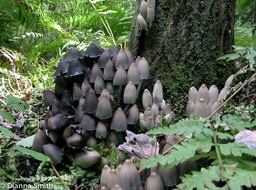
Coprinopsis atramentaria
COPRINOPSIS
Another edible coprinoid mushroom frequently seen is Coprinopsis (which means "like Coprinus") atramentaria, the mushroom that causes an unpleasant reaction when accompanied by alcohol. Like other mushrooms in this genus, it emerges from a universal veil and exhibits a ring. The largest number of coprinoid mushroom are now in Coprinopsis with roughly a hundred species assigned to this new genus.

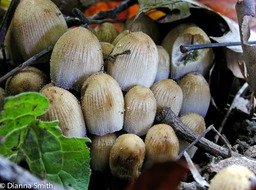
Coprinellus micaceus, ‘Mica Cap'
COPRINELLUS
A characteristic of the mushrooms in the genus Coprinellus ("little Coprinus") is the mica-like granular scales seen on the caps of familiar mushrooms like the Mica Cap. These are remnants of their universal veils. The coprinoid mushrooms that exhibit the orange mycelia mat called an ozonium at their base are also in the genus These are just a few examples of the over forty species in this genus that additionally includes the familiar Coprinellus disseminatus and Coprinellus radians.

Coprinellus disseminatus
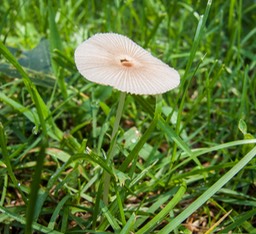
PARASOLA
Mushrooms in the genus Parasola on the other hand lack a universal veil and consequently don't have veil remnants or rings on them. They also don't deliquesce. They tend to be tiny and exhibit umbrella-shaped caps. One beautiful example we frequently find is the species type for this genus, Parasola plicatilis, which is found in lawns. There are just over twenty or so mushrooms worldwide in this genus.

Parasola plicatilis
Not all coprinoid mushrooms can be so easily identified macroscopically as belonging to one of these groups. Microscopic, chemical (KOH) and ultimately DNA sequencing is the only way many can be correctly assigned to one of the four genera.
Now for another mind bender....Coprinus comatus has been put in the Agaricaecae rather than the Psathyrellaceae, which led mycologist, Lorelei Norvel*, to argue that it should be bumped and replaced by Coprinopsis atramentaria. Although she had some support for the proposal, in 2005 the International Botanical Congress (IBC) voted to accept the conserved name. But who knows what changes the future may bring? In the meantime, don’t forget to consult www.indexfungorum.org/names/Names.asp to verify the most recently accepted name of your coprinoid mushroom finds. The current name will appear in green.
You can read more on the coprinoid mushrooms at Tom Volk’s Mushroom of the Month pages: http://botit.botany.wisc.edu/toms_fungi/may2004.html, Michael Kuo’s Mushroom Expert site http://www.mushroomexpert.com/coprinus_comatus.html and by reading the studies of Scottt Redhead(2001) "Bully for Coprinus - - a story of manure, minutiae, and molecules" McIlvainea 14(2): 5 –14. “Coprinus: Persoon and the disposition of Coprinus species sensu lato” (2001) by Scott A. Redhead, Rytas Vilgalys, Jean-Marc Moncalvo, Jacqui Johnson & John S. Hopple, Jr. Taxon 50:203-241. Both of these articles can be found online as well. See also the Cornell Blog by Kathy Hodge at http://blog.mycology.cornell.edu/2008/07/01/the-dish-on-deliquescence-in-coprinus-species/
*See Inoculum 52(5) 2001, p. 5 at
http://www.science.ulst.ac.uk/rtm/Coprinus.html